Traditional acoustic materials often rely on thickness to achieve noise reduction. Foam layers, insulation boards, and dense barriers typically improve performance by increasing material depth. While effective, this approach adds bulk and takes up valuable space.
Thin acoustic materials offer a different approach. Instead of depending solely on mass, they are engineered to manage vibrational energy more efficiently within a reduced profile.
SoundBounce demonstrates this approach by delivering effective noise reduction in a profile up to 4x thinner than conventional acoustic materials.
Why Traditional Acoustic Materials Require Thickness for Noise Reduction
Conventional acoustic materials reduce noise primarily through mass and absorption. Increasing thickness helps damp sound transmission and absorb acoustic energy. However, this means performance improvements often come with increased material depth.
In construction, thicker materials can reduce usable internal space. In mechanical systems, additional thickness can limit component placement or require structural adjustments. Over time, these space constraints can influence overall system design and value.
How Thin Acoustic Materials Achieve Noise Reduction
Thin acoustic materials achieve noise reduction differently. Rather than relying purely on bulk material depth, they use engineered internal structures to dissipate vibrational energy more efficiently.
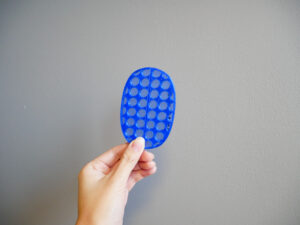
SoundBounce uses a composite cellular architecture designed to control how vibrational energy moves through the material. By managing energy within its internal structure, it reduces noise transmission without requiring excessive thickness.
This advanced materials approach allows effective acoustic performance to be delivered within a significantly reduced profile.
SoundBounce as an Advanced Material for Thin Acoustic Noise Reduction
SoundBounce is an advanced acoustic composite material developed to overcome the limitations of thickness-dependent solutions. While many conventional materials require added depth to improve performance, SoundBounce achieves comparable noise reduction while significantly reducing required material depth.
This reduction in profile helps preserve valuable internal space in buildings, enclosures, and mechanical systems. It also simplifies integration where dimensional constraints are critical.
By combining advanced acoustic engineering with a thin material profile, SoundBounce demonstrates how thin acoustic materials can deliver practical and efficient noise reduction.
Thin Acoustic Materials in Real-World Applications
In aerospace structures, vehicle assemblies, and industrial enclosures, internal space is tightly controlled. Structural elements, wiring systems, thermal components, and mechanical parts must all fit within fixed dimensions.
When acoustic materials require excessive thickness, surrounding components may need to be repositioned or structural envelopes expanded. Thin acoustic materials reduce this constraint. By reducing required acoustic depth, SoundBounce allows noise reduction to be integrated without increasing system dimensions or forcing redesign.